
Dolly Parton Net Worth at a Glance
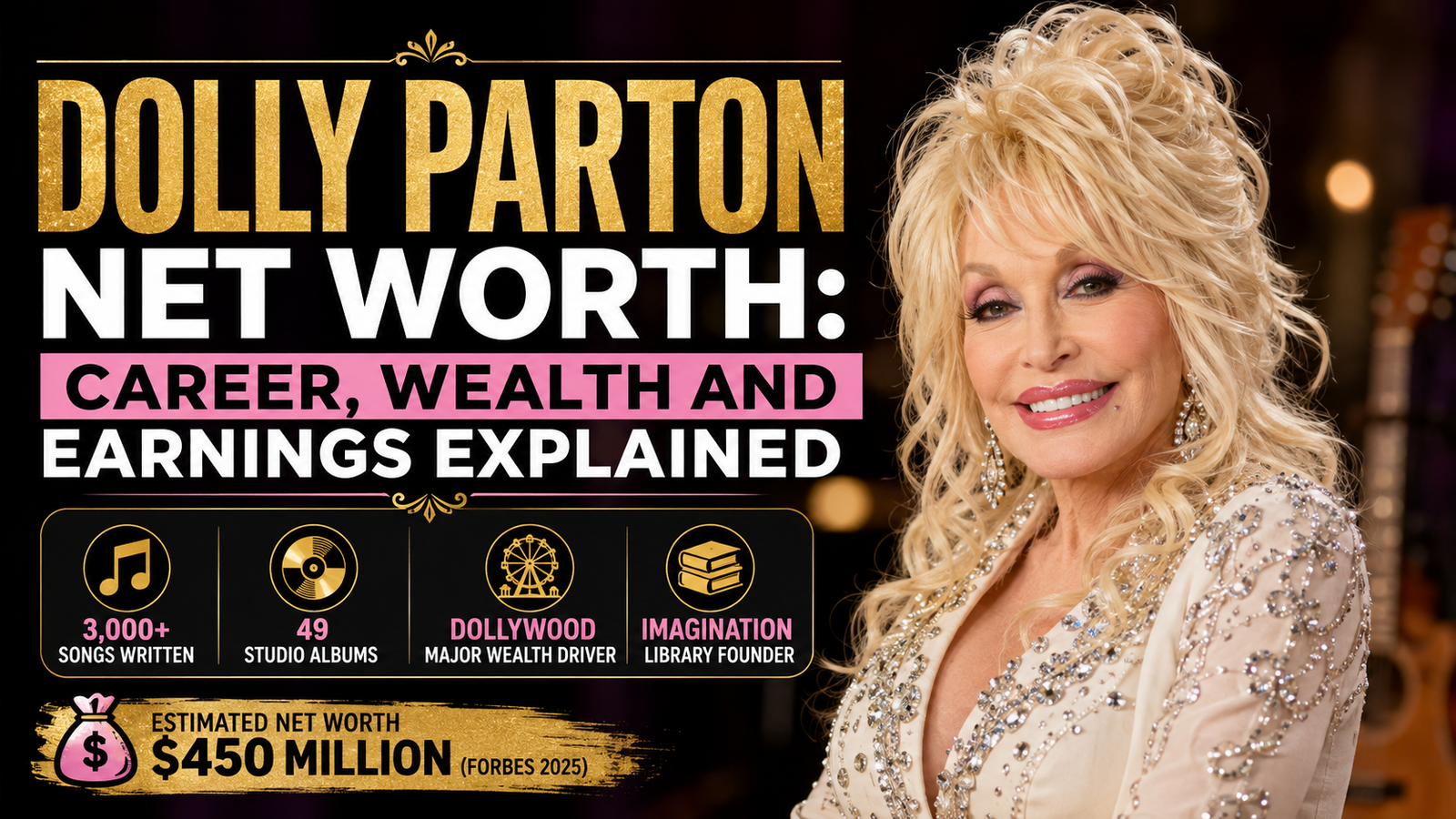
As of the latest widely reported Forbes estimate, Dolly Parton’s net worth was approximately $450 million. Forbes’ profile identifies Dollywood as the primary source of her fortune, while also highlighting the considerable value of her songwriting catalogue.
| Category | Key information |
|---|---|
| Estimated net worth | Approximately $450 million |
| Main wealth driver | Ownership stake in Dollywood |
| Music catalogue | More than 3,000 songs |
| Major songs | “Jolene”, “9 to 5”, “I Will Always Love You” |
| Recording career | 49 studio albums |
| Records sold | Around 100 million, according to Forbes |
| Major philanthropic project | Dolly Parton’s Imagination Library |
| Business role | Singer, songwriter, entrepreneur, producer and investor |
The $450 million figure should be viewed as an estimate rather than a precise bank balance. Celebrity wealth calculations generally involve estimating the value of private businesses, intellectual property, investments and other assets.
A note about the date of the estimate
Forbes’ $450 million figure was published as part of its 2025 wealth assessment and remains one of the most clearly documented estimates available. Forbes subsequently reported Parton’s death in August 2026, while continuing to reference the approximately $450 million valuation.
That distinction matters because net worth can change when assets are sold, transferred, valued differently or incorporated into an estate.
How Dolly Parton Built Her Wealth
Dolly Parton’s financial story is unusual because she developed several complementary sources of income rather than relying on one career.
Her wealth-building journey can broadly be divided into five areas:
- Songwriting and music royalties
- Recording and performing
- Dollywood and related businesses
- Film, television and publishing
- Brand and intellectual-property opportunities
This diversified approach helped turn a successful entertainment career into a much larger business empire.
Instead of treating music as her only source of income, Parton repeatedly looked for ways to build long-term value around her creative work and public identity.
Dolly Parton’s Music Career and Earnings
Music was the foundation of Parton’s career.
She began performing professionally at a young age and eventually moved to Nashville, where she established herself as a songwriter and performer. Her career expanded significantly after she began receiving national attention through television appearances and collaborations.
Over time, Parton released dozens of albums and recorded songs that became staples of country music.
According to Forbes, she released 49 studio albums during her recording career and had more than two dozen albums or recordings certified Gold or Platinum by the Recording Industry Association of America. Forbes also reported that she had sold around 100 million records.
Touring and live performances
Concerts and touring have historically been another important revenue stream for major recording artists.
Parton’s live career included:
- Concert tours
- Television performances
- Special appearances
- Residency-related projects
- Festival and industry performances
Touring can produce significant gross revenue, although gross ticket sales are not the same as an artist’s personal earnings. Promoters, venues, musicians, production companies, management and other parties receive portions of the revenue.
For Parton, however, live performance also reinforced the value of her broader brand.
The Value of Dolly Parton’s Songwriting Catalogue
One of the most important elements of Dolly Parton net worth is her songwriting.
Parton did not simply perform songs written by other people. She wrote many of her most famous works herself, giving her an ongoing economic interest in the underlying compositions.
Her catalogue contains more than 3,000 songs, according to Forbes. Among the best-known are “Jolene”, “9 to 5” and “I Will Always Love You”.
Why songwriting rights matter
A songwriter can potentially earn money when a composition is:
- Recorded
- Streamed
- Downloaded
- Performed publicly
- Used in television
- Used in films
- Licensed commercially
- Covered by another artist
This makes successful songwriting particularly valuable because a popular composition can generate income over many years.
“I Will Always Love You”
One of Parton’s most financially important compositions is “I Will Always Love You”.
Parton wrote and originally recorded the song before Whitney Houston’s enormously successful 1992 version introduced it to another generation of listeners.
The song’s history illustrates why owning valuable songwriting rights can be more powerful financially than simply receiving payment for performing a recording.
Forbes estimated Parton’s song catalogue at approximately $120 million in 2025, illustrating the substantial value associated with her intellectual property.
How Dollywood Became a Major Part of Her Wealth
Music made Dolly Parton famous, but Dollywood became one of the most important pieces of her business empire.
Parton invested in the Pigeon Forge, Tennessee theme park in 1986. The attraction was subsequently renamed Dollywood, transforming it into a destination strongly associated with Parton’s identity and the culture of the Smoky Mountains.
Why Dollywood matters financially
Theme parks are fundamentally different from music recordings.
A song can generate royalties whenever it is used, but a successful theme park can generate revenue through multiple channels, including:
- Admission tickets
- Food and beverages
- Merchandise
- Accommodation
- Seasonal events
- Entertainment
- Water-park operations
- Other visitor experiences
Parton’s involvement also helped differentiate the attraction from a conventional amusement park.
The Dollywood brand combines entertainment with Parton’s personal story, Appalachian heritage and musical identity.
More than a theme park
The wider Dollywood operation has expanded beyond the original park concept, including accommodation and water-park attractions. Forbes has identified Parton’s stake in the Dollywood Company as the principal source of her fortune.
This is a useful lesson in celebrity entrepreneurship: the most valuable asset may not always be the celebrity’s direct performance income. It can be the business built around the celebrity’s brand.
Dolly Parton’s Other Business Ventures
Parton’s entrepreneurial activities extend beyond Dollywood.
Over her career, she has developed commercial opportunities connected to entertainment, publishing, licensing and consumer products.
Her name itself became a valuable intellectual-property asset.
A recognisable personal brand can support:
- Merchandise
- Books
- Licensing agreements
- Entertainment productions
- Film projects
- Music releases
- Television specials
- Brand partnerships
The important point is that these ventures should not automatically be interpreted as separate fortunes. Many operate within a wider business ecosystem built around Parton’s intellectual property and public identity.
Acting, Television and Publishing Income
Dolly Parton also generated income through acting and television.
Her film career included major productions such as 9 to 5, The Best Little Whorehouse in Texas, Steel Magnolias and The Best Little Whorehouse in Texas. Her screen work expanded her audience beyond country music.
She also appeared in television programmes and specials and participated in projects connected to her music.
Books and publishing
Parton has also been an author.
Her writing career includes children’s books and other literary projects. She co-wrote the novel Run, Rose, Run with James Patterson, further demonstrating how she extended her creative brand into publishing. Forbes lists the book among her published works.
Publishing can also complement a musician’s business strategy because books provide another way to reach audiences while strengthening the underlying personal brand.
Dolly Parton and Philanthropy
Discussing Dolly Parton net worth without discussing her philanthropy would provide an incomplete picture of her financial legacy.
One of her most recognised charitable initiatives is Dolly Parton’s Imagination Library.
The programme began in 1995 in her home county in East Tennessee. Its goal was to encourage young children to develop a love of reading by providing books to families.
The programme has since expanded internationally.
According to the organisation, the Imagination Library operates across the United States, Canada, the United Kingdom, Australia and the Republic of Ireland and provides millions of books each month.
How the Imagination Library works
The programme provides age-appropriate books to children from birth through age five.
The books are mailed directly to participating children, helping make reading a regular part of family life.
Parton’s philanthropy has also included support for medical research, disaster relief and other charitable causes. Forbes reported that she donated $1 million towards COVID-19 research and supported communities affected by wildfires and other disasters.
This is significant because wealth is not only about accumulation. Parton’s career demonstrates how a high-income celebrity can use financial resources to fund long-term charitable projects.
Why Celebrity Net Worth Figures Should Be Treated Carefully
When searching for Dolly Parton net worth, readers will find different numbers across the internet.
This happens because net worth is not normally a publicly audited figure.
A simple calculation looks like this:
Net worth = total assets − total liabilities
But estimating a celebrity’s assets can be difficult.
Private business valuations
A private company does not have a constantly visible market price like a publicly traded stock.
The value assigned to a private business can change according to:
- Revenue
- Profitability
- Assets
- Debt
- Market conditions
- Future growth expectations
- Comparable businesses
Therefore, an estimate of Parton’s wealth can change without her necessarily receiving or losing hundreds of millions of dollars in cash.
Intellectual property is difficult to value
Song catalogues are particularly complicated.
The value of a catalogue depends on its historical income, future licensing potential, streaming performance, ownership structure and market demand.
For this reason, the value of Parton’s music rights should be understood as an estimated asset value rather than money sitting in a bank account.
What Makes Dolly Parton’s Business Strategy Different?
Parton’s career offers several useful lessons for entrepreneurs and creators.
1. Create assets, not just income
Performing can produce income, but songwriting creates intellectual property that can continue generating value.
Parton wrote songs that remained commercially relevant for decades.
2. Diversify carefully
Her business interests span entertainment, tourism, publishing and philanthropy.
This reduced her dependence on any single source of revenue.
3. Build a recognisable brand
Parton’s distinctive personality and image became inseparable from her business activities.
That consistency helped audiences recognise and trust projects carrying her name.
4. Think beyond the original industry
Parton’s career started in music, but her wealth expanded through tourism, entertainment, publishing and other commercial activities.
This demonstrates how an established audience can provide a foundation for entering adjacent industries.
5. Turn creative work into long-term intellectual property
Perhaps the biggest financial lesson is the importance of ownership.
A creator who owns valuable rights can potentially benefit from that work for decades.
Dolly Parton’s Career in Numbers
Here is a simplified overview of some of the figures associated with Parton’s career:
| Measure | Reported figure |
|---|---|
| Forbes net-worth estimate | $450 million |
| Song catalogue | 3,000+ songs |
| Studio albums | 49 |
| Reported record sales | Around 100 million |
| Estimated song catalogue value in 2025 | About $120 million |
| Imagination Library launch | 1995 |
| Dollywood investment | 1986 |
These figures come from Forbes and Dolly Parton’s Imagination Library.
They should be treated as reported estimates and career milestones rather than exact measures of cash or annual income.
Is Dolly Parton Still Earning Money From Her Music?
Music can continue generating revenue after an artist stops actively touring.
Parton’s compositions can remain commercially valuable through:
- Streaming
- Radio
- Film and television licensing
- Cover versions
- Public performances
- Compilation albums
- Digital sales
Her songs have also continued to reach younger audiences through streaming platforms. Forbes reported that Parton had an average of 16.2 million monthly Spotify listeners and that “Jolene” had surpassed 950 million streams at the time of its 2026 reporting.
This illustrates the long-term economic power of a strong music catalogue.
The Bigger Picture Behind Dolly Parton Net Worth
The most useful way to understand Dolly Parton net worth is not to focus solely on the $450 million headline figure.
Her financial success came from combining several forms of value:
Creative value → Music → Songwriting rights → Brand → Businesses → Long-term assets
Her songwriting created intellectual property.
Her music created an international audience.
Her reputation strengthened her brand.
Her brand helped support businesses such as Dollywood.
And her financial success gave her the resources to fund charitable initiatives such as the Imagination Library.
That combination is what makes her career particularly interesting from a business perspective.
Conclusion
Dolly Parton’s estimated $450 million net worth reflects much more than decades of successful music sales. Her fortune was built through songwriting, recordings, performances, business ownership, entertainment projects and the careful development of one of the most recognisable personal brands in popular culture. Forbes identifies her stake in Dollywood as the biggest contributor to her wealth, while her extensive songwriting catalogue represents another major asset.
Her career also demonstrates the financial importance of ownership. Rather than relying exclusively on performance income, Parton created and retained valuable intellectual property and expanded into businesses that could operate independently of touring.
At the same time, her legacy cannot be measured only in dollars. Through Dolly Parton’s Imagination Library and other charitable efforts, she directed substantial resources towards education, children and communities. The programme she launched in 1995 continues to provide books to children internationally.
For anyone studying celebrity wealth, entrepreneurship or the music business, Parton’s career provides a powerful example of how creativity, ownership, diversification and long-term brand building can work together.