
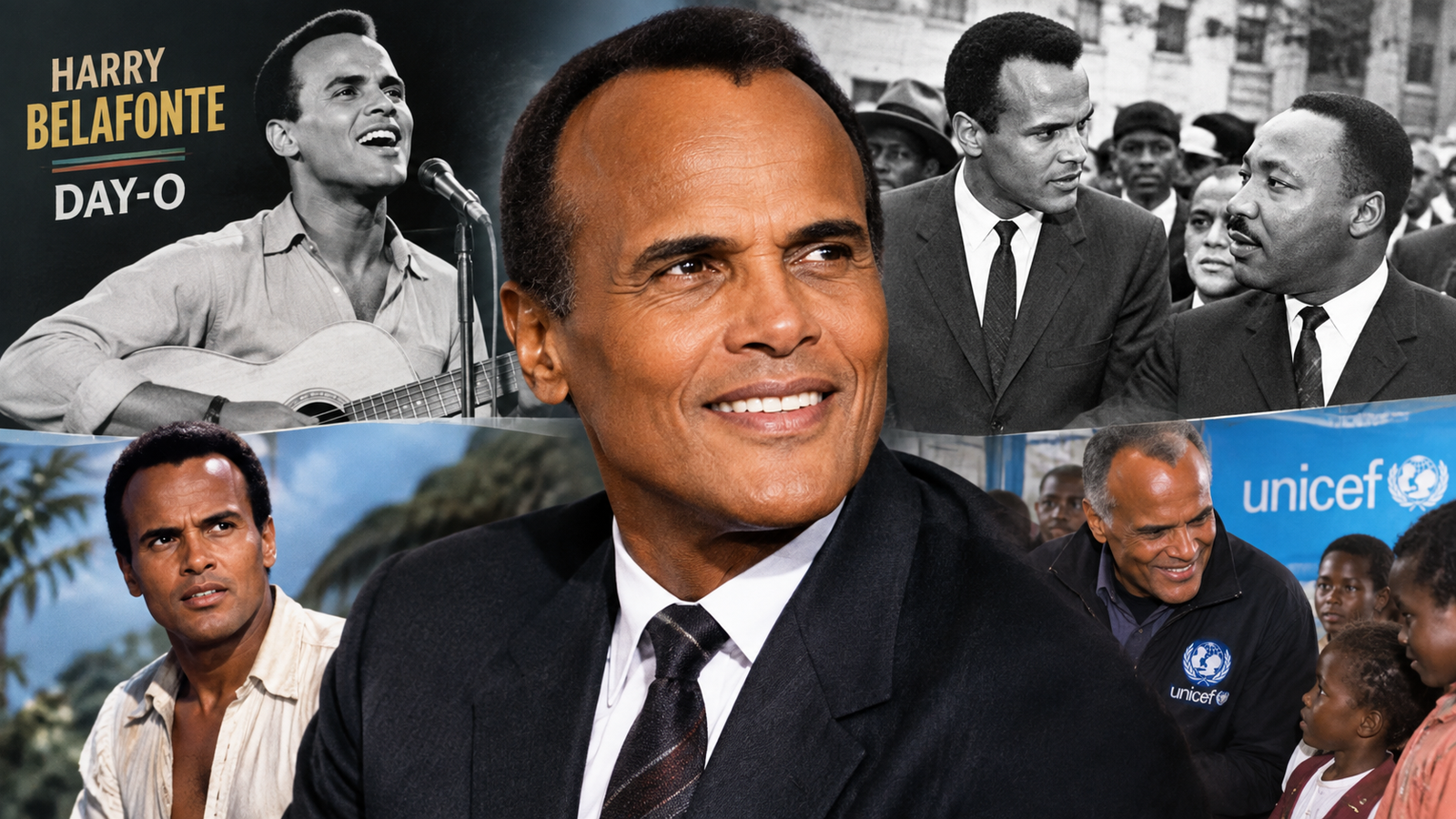
Harry Belafonte was far more than a successful entertainer. Across a career spanning music, film, television and humanitarian work, he became one of the most visible Black performers of his generation and a prominent voice in the American civil rights movement.
Born in New York City in 1927 to a Jamaican-American family, Belafonte served in the U.S. Navy during World War II before building a career as a performer. He eventually became an internationally recognized singer and actor while using his public profile to support racial equality, humanitarian causes and social justice. The National Archives describes him as an entertainer, veteran and activist whose records are closely connected with the history of the civil rights movement.
His influence is especially notable because he did not treat activism as something separate from his entertainment career. Music and film gave him a large audience, but he repeatedly used that visibility to support causes he believed in.
Who Was Harry Belafonte?
Harry Belafonte was an American singer, actor and social activist best known for popularizing Caribbean-influenced music internationally and for his involvement in the U.S. civil rights movement.
He was born Harold George Bellanfanti Jr. on March 1, 1927, in New York City. His family background was Jamaican, and his childhood experiences helped shape his connection to Caribbean culture.
After military service during World War II, Belafonte pursued performance. He worked in theater before establishing himself as a singer, and his career eventually expanded into movies and television.
The National Archives notes that Belafonte achieved EGOT status, meaning he won an Emmy, Grammy, Oscar and Tony during his career.
That combination of artistic recognition and political engagement made him unusual among major entertainers of his era.
Harry Belafonte and Music
Music was the foundation of Belafonte’s fame.
He became closely associated with Caribbean and folk music, helping introduce a much wider American audience to styles influenced by calypso. His 1956 album Calypso became a landmark commercial success and helped establish him as an international star.
One of the songs most closely associated with him is “Day-O (The Banana Boat Song).” Its memorable call-and-response structure became part of American popular culture and remains one of the best-known recordings connected with Belafonte.
His success also mattered culturally. At a time when opportunities for Black performers were heavily restricted, Belafonte became a major mainstream star without abandoning the musical traditions that influenced him.
Rather than fitting neatly into one genre, his recordings drew from Caribbean music, folk traditions and popular entertainment. That broad appeal helped make him one of the most recognizable performers of the 1950s.
His Acting Career
Belafonte also established himself as a film and television actor.
His screen career included films such as Carmen Jones, Island in the Sun, Odds Against Tomorrow, Buck and the Preacher and Uptown Saturday Night.
His film choices often carried social or cultural significance. Belafonte was willing to take on roles and projects that addressed race, inequality and the experiences of Black Americans.
He also worked behind the scenes as a producer, giving him greater control over the kinds of stories reaching audiences.
The National Archives describes his career as extending from his rise as a singer into Hollywood, while also emphasizing the connection between his entertainment work and activism.
Harry Belafonte and the Civil Rights Movement
For many people, Belafonte’s most enduring contribution was his civil rights activism.
He became a close friend and supporter of Dr. Martin Luther King Jr. and was deeply involved in the movement during the 1950s and 1960s. He used his financial resources, celebrity connections and organizational abilities to support civil rights campaigns.
The National Archives records his participation in the 1963 March on Washington and describes his broader work with King and other civil rights leaders.
Belafonte was not simply a celebrity who appeared at occasional events. He became involved in fundraising and organizing and provided financial support to civil rights organizations.
His relationship with King was particularly significant. Belafonte helped support the movement financially at moments when activists faced serious personal and organizational pressures.
The National Archives also documents Belafonte’s involvement with the Student Nonviolent Coordinating Committee and his work surrounding the 1963 March on Washington.
His Friendship With Martin Luther King Jr.
Belafonte and King developed a close personal relationship during the civil rights era.
Their friendship reflected an important division of labor within the movement. King was a central public leader, while Belafonte could use his entertainment career, wealth and connections to provide resources and reach audiences beyond traditional movement organizations.
Belafonte later remained involved with King’s family and legacy. National Archives records, for example, document Belafonte’s presence in Atlanta shortly after King’s death in 1968 in connection with projects involving King’s speeches.
That history helps explain why Belafonte’s name continues to appear in archival records concerning the civil rights movement.
Humanitarian Work and UNICEF
Belafonte’s activism extended well beyond the United States.
He became a UNICEF Goodwill Ambassador and used his international profile to draw attention to children’s rights and humanitarian issues. UNICEF’s historical records identify him among the prominent artists who contributed their time and influence to the organization.
His work with UNICEF included public advocacy and international missions. A 1995 UNICEF report, for example, records Belafonte and his wife Julie visiting UNICEF-supported centers serving unaccompanied children in Rwanda and Goma.
UNICEF continues to list Harry Belafonte among its legacy ambassadors, recognizing the long-term contribution of former ambassadors to the organization’s mission.
This part of his career demonstrates how his activism developed from domestic civil rights into broader international humanitarian work.
Harry Belafonte and “We Are the World”
Belafonte also played an important role in the charity effort that became USA for Africa.
In 1985, he worked with other major entertainers to support famine relief in Africa. The resulting campaign produced We Are the World, performed by a large group of leading American musicians.
The project became one of the most famous examples of entertainers using their collective influence for humanitarian fundraising.
For Belafonte, however, this was consistent with a much longer pattern. He had already spent decades connecting entertainment with activism rather than treating charitable work as a separate part of his public life.
His Work Against Apartheid
Belafonte’s activism continued into the later decades of the 20th century.
He spoke out against apartheid in South Africa and supported efforts connected to the struggle for racial equality there. He also helped raise the international profile of African artists, including South African singer Miriam Makeba.
The National Archives notes that Belafonte continued his activism into the late 20th and early 21st centuries, including work against apartheid and advocacy on other international and domestic issues.
His activism therefore cannot be reduced to one period. Civil rights remained a central theme, but his interests expanded into humanitarian relief, international justice and other social issues.
Awards and Recognition
Belafonte’s achievements were recognized across entertainment and public service.
Among his distinctions was the rare EGOT combination of an Emmy, Grammy, Oscar and Tony. The National Archives also notes that he received the Distinguished American Award from the John F. Kennedy Library and Foundation in 2002.
He also received recognition from civil rights organizations, including the NAACP’s Spingarn Medal in 2013.
These awards tell only part of the story. His broader legacy comes from the way his artistic career and activism developed alongside each other.
Why Harry Belafonte Still Matters
The significance of Belafonte’s career lies partly in the unusual combination of talents and responsibilities he embraced.
He was a successful recording artist, a Hollywood actor, a producer, a veteran and a committed activist. Each role gave him another platform from which to reach people.
His career also provides a useful reminder that celebrity activism is not a new phenomenon. Belafonte was using fame, money and professional connections to support social causes decades before social media transformed how public figures communicate with audiences.
The National Archives holds extensive material relating to his activism, including photographs, documents and recordings.
That archival record makes it possible to study his work not simply as celebrity history, but as part of the documented history of American civil rights.
When Did Harry Belafonte Die?
Harry Belafonte died on April 25, 2023, at the age of 96.
The National Archives confirmed his death and highlighted his combined legacy as an entertainer, veteran and civil rights activist.
His death marked the end of a career that had lasted more than seven decades, but his music, films, humanitarian work and civil rights contributions remain part of the historical record.
Frequently Asked Questions About Harry Belafonte
Who was Harry Belafonte?
Harry Belafonte was an American singer, actor, producer and activist. He became internationally famous through music and film and was a major supporter of the U.S. civil rights movement.
What was Harry Belafonte famous for?
He was particularly known for popularizing Caribbean-influenced music, including the famous song “Day-O (The Banana Boat Song),” as well as for his acting career and civil rights activism.
Was Harry Belafonte friends with Martin Luther King Jr.?
Yes. Belafonte was a close friend and supporter of Dr. Martin Luther King Jr. and provided financial and practical support to the civil rights movement.
Was Harry Belafonte a UNICEF ambassador?
Yes. Belafonte served as a UNICEF Goodwill Ambassador and worked to raise awareness of children’s rights and humanitarian issues around the world.
Did Harry Belafonte win an EGOT?
Yes. The National Archives identifies Belafonte as an EGOT recipient, meaning he won an Emmy, Grammy, Oscar and Tony.
When did Harry Belafonte die?
Harry Belafonte died on April 25, 2023. He was 96 years old.
What is Harry Belafonte’s legacy?
His legacy combines music, acting, civil rights activism and humanitarian work. He is remembered not only as a major entertainer but also for using his resources and public influence to support social and humanitarian causes.
Final Thoughts
Harry Belafonte’s story is difficult to separate into neat categories. The singer was also an actor. The actor was also a producer. And the internationally recognized entertainer became one of the most active celebrity supporters of civil rights and humanitarian causes of his generation.
His music introduced millions of listeners to Caribbean sounds, while his activism connected him to some of the defining social movements of the 20th century. His work with Martin Luther King Jr., UNICEF and international humanitarian campaigns extended his influence far beyond the stage and screen.
For that reason, the story of Harry Belafonte is ultimately about more than fame. It is about how an artist used his visibility, relationships and resources to participate in causes that continued long after his biggest musical hits.