

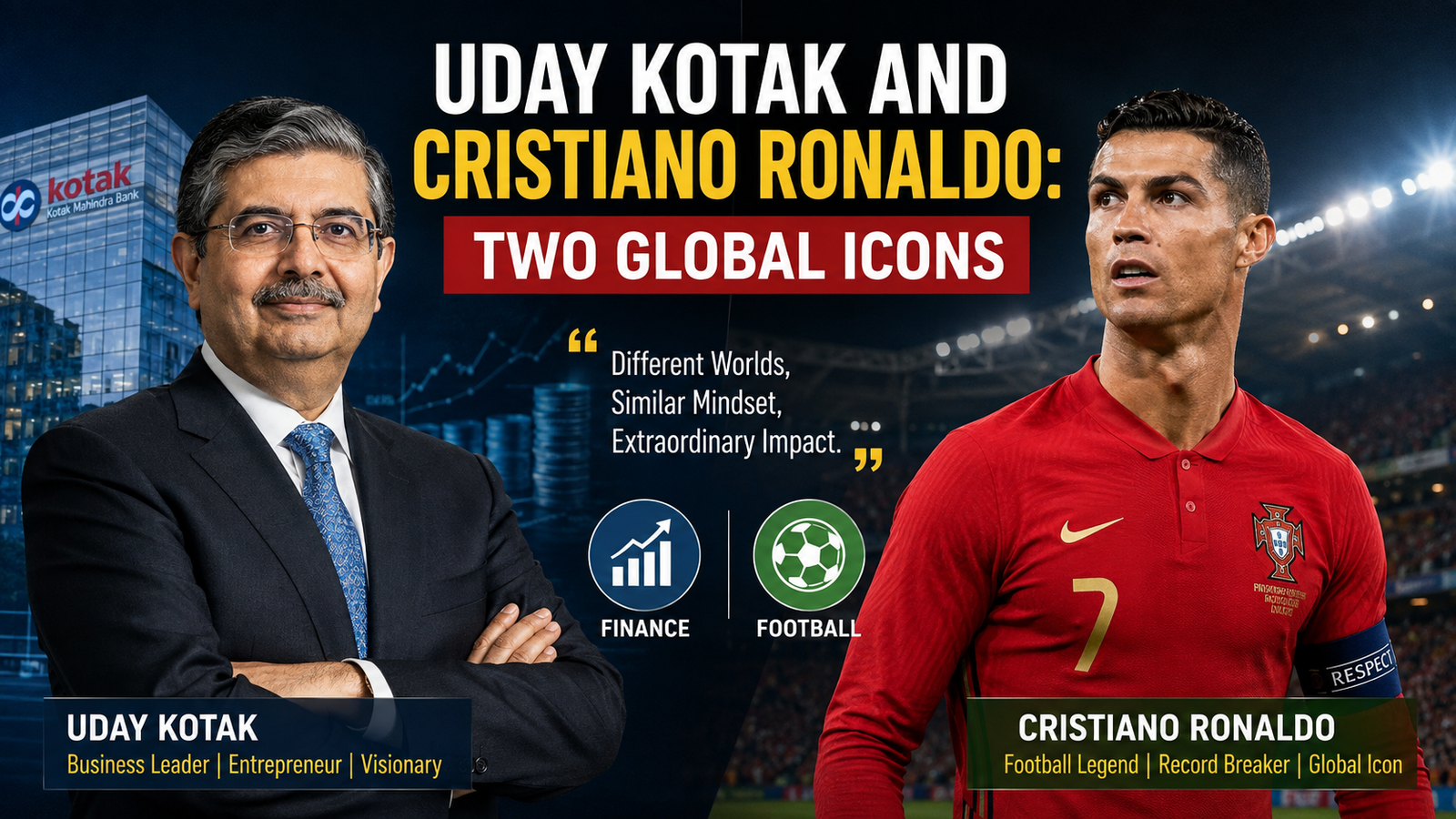
Who Is Uday Kotak?
Uday Kotak is an Indian entrepreneur and financial-services leader best known for his role in building the Kotak financial-services business.
His professional story is closely connected with the growth of Kotak Mahindra Bank and the wider Kotak Group. Corporate material has described Kotak as the bank’s promoter and a leader whose organisation expanded across areas including banking, stock broking, investment banking, car finance, insurance and asset management.
His journey is particularly interesting because it reflects the transformation of an entrepreneurial financial business into a much larger institution.
From Finance Entrepreneur to Institution Builder
Kotak’s career illustrates a principle that is important in business: building a successful organisation is different from simply creating a successful product.
Financial services depend heavily on trust, risk management and long-term relationships. A bank also has to operate within a highly regulated environment while responding to changing economic conditions and customer expectations.
That makes institution-building a long-term exercise.
Kotak’s career has therefore been associated not only with entrepreneurship but also with strategic thinking, financial management and organisational development.
Recognition for Business Leadership
Kotak has received a number of business and entrepreneurship awards over the course of his career. A Kotak Mahindra Bank annual report lists honours including the EY World Entrepreneur of the Year Award in 2014, the Economic Times Business Leader of the Year Award and other business leadership recognitions.
These recognitions reflect the broader influence of his work in India’s financial sector.
Who Is Cristiano Ronaldo?
Cristiano Ronaldo is a Portuguese footballer whose career has extended across some of the biggest clubs and competitions in world football.
He first emerged internationally as a young player at Sporting CP before developing into a global superstar during spells with Manchester United, Real Madrid and Juventus. He later returned to Manchester United before moving to Saudi Pro League club Al Nassr in 2023. FIFA’s profile of Ronaldo highlights his evolution from a skilful young winger into a highly prolific goalscorer.
His career has been defined by goals, trophies, individual awards and remarkable longevity.
Ronaldo’s Record-Breaking Career
Ronaldo’s statistical achievements provide one of the clearest measures of his influence.
As of July 2026, UEFA listed him as the record-holder for men’s international goals, with 146 goals for Portugal in 233 appearances.
He also holds an extraordinary collection of UEFA Champions League records.
According to UEFA, Ronaldo has:
- 140 Champions League goals
- 183 Champions League appearances
- Five Champions League titles
- Seven Champions League top-scoring campaigns
- A record 17 goals in the 2013/14 Champions League season
- 67 knockout-stage Champions League goals
His longevity is equally remarkable. At the 2026 FIFA World Cup, Ronaldo became the first player to score at six different World Cups. FIFA later reported that he played his final World Cup match in July 2026 following Portugal’s elimination by Spain.
Uday Kotak and Cristiano Ronaldo: A Comparison
Despite operating in different fields, the two careers can be compared through several broad themes.
| Area | Uday Kotak | Cristiano Ronaldo |
|---|---|---|
| Primary field | Banking and financial services | Professional football |
| Country associated with career | India | Portugal |
| Core strength | Entrepreneurship and institution-building | Athletic performance and goal-scoring |
| Main arena | Business and finance | International and club football |
| Leadership style | Strategic and institutional | Performance-driven and competitive |
| Global influence | Finance and business | Sport and popular culture |
| Career lesson | Build for the long term | Maintain elite performance over time |
| Major legacy | Financial institution building | Football records and sporting achievements |
The comparison should not suggest that their achievements are identical. They are not.
Rather, it shows how different forms of excellence can emerge from similar principles.
Different Industries, Similar Mindsets
What Do Uday Kotak and Cristiano Ronaldo Have in Common?
The strongest connection between Uday Kotak and Cristiano Ronaldo is not their professions. It is their approach to sustained achievement.
1. Long-Term Thinking
Building a major financial institution takes years of planning and execution.
Likewise, maintaining an elite football career for more than two decades requires much more than natural ability.
Ronaldo’s career demonstrates this particularly clearly. His playing style evolved as he aged. He developed from a winger known heavily for dribbling and explosiveness into a forward whose positioning, movement and finishing became central to his game. FIFA has specifically highlighted this evolution.
In business, long-term thinking can involve:
- Investing in people
- Building customer trust
- Managing risk
- Developing strong systems
- Responding to market changes
In sport, it can involve:
- Training consistently
- Maintaining physical fitness
- Studying opponents
- Adjusting technique
- Managing a long career
The details differ, but the principle remains similar: lasting success requires thinking beyond the next result.
Uday Kotak’s Approach to Business and Leadership
Why Is Uday Kotak Significant in Indian Business?
Kotak’s significance comes from his association with the development of a major Indian financial-services institution.
Banking is an industry where reputation and confidence are fundamental. Customers entrust financial institutions with savings, investments and major financial decisions.
Consequently, leadership requires more than aggressive growth.
It requires balancing growth with:
- Risk management
- Regulation
- Customer confidence
- Capital management
- Corporate governance
- Technology
- Talent development
Kotak’s career provides an example of how entrepreneurship can evolve into institution-building.
The Bigger Business Lesson
One useful lesson from his career is that successful entrepreneurs eventually need to build systems that work beyond the individual founder.
A small business may initially depend heavily on one person’s decisions. A large institution cannot operate that way indefinitely.
It needs:
- Strong leadership.
- Experienced teams.
- Clear processes.
- Effective governance.
- Sustainable financial management.
- The ability to adapt to changing markets.
This distinction between founder success and institutional success is important for entrepreneurs.
Cristiano Ronaldo’s Approach to Football and Performance
How Did Ronaldo Maintain Elite Performance?
Ronaldo’s career is an example of continual adaptation.
Early in his career, he was widely recognised for pace, dribbling and one-on-one ability. Over time, his game became increasingly focused on movement, positioning and finishing.
That transition matters because physical abilities naturally change with age.
Rather than attempting to play exactly as he did as a younger athlete, Ronaldo adapted his role.
His Champions League record demonstrates the results of that evolution. UEFA records him as the competition’s all-time leading scorer, with 140 goals in 183 appearances.
Discipline and Preparation
Elite sport demands preparation before the audience ever sees the performance.
Training, recovery, nutrition, tactical preparation and mental focus all contribute to match-day results.
Ronaldo’s career demonstrates why consistency can become a competitive advantage.
A single outstanding season can create attention.
Two decades of elite performances create a legacy.
The Importance of Long-Term Consistency
One of the clearest similarities between Uday Kotak and Cristiano Ronaldo is the importance of consistency.
Business and sport both contain periods of uncertainty.
A company can face:
- Economic downturns
- New competitors
- Regulatory changes
- Technological disruption
- Changing customer expectations
An athlete can face:
- Injuries
- Ageing
- Changes in coaches
- Competition from younger players
- Changes in tactics
- Loss of form
Success therefore cannot depend entirely on favourable circumstances.
The ability to continue improving during difficult periods becomes crucial.
Consistency Does Not Mean Doing the Same Thing
This is an important distinction.
Consistency means maintaining standards, not refusing to change.
Ronaldo’s evolution on the pitch is a useful example. His role changed while his ambition to score and perform remained constant. FIFA’s career profile describes this transformation from a fleet-footed winger into a highly productive goalscorer.
For business leaders, the equivalent is adapting products, technology and strategies while maintaining the organisation’s core purpose.
Adaptability as a Key to Success
How Can Professionals Apply Their Example?
The careers of Uday Kotak and Cristiano Ronaldo offer a practical lesson: adapt before circumstances force you to adapt.
For a business professional, this might mean learning:
- Artificial intelligence
- Data analysis
- Digital marketing
- Financial technology
- Leadership
- Communication
- Cybersecurity
For an athlete, adaptation may involve:
- Changing training methods
- Improving recovery
- Adjusting tactics
- Refining technique
- Managing workload
The exact skills are different, but the underlying mindset is transferable.
A Simple Adaptation Framework
Professionals can ask themselves four questions:
- What is working today?
- What may stop working tomorrow?
- What new skill would increase my value?
- What should I stop doing because circumstances have changed?
These questions encourage proactive rather than reactive thinking.
Personal Branding and Global Recognition
Why Are Both Names So Recognisable?
Uday Kotak and Cristiano Ronaldo also demonstrate two different forms of personal branding.
Ronaldo’s personal brand is highly visible because football is a global entertainment industry. His name is associated with performance, competition and sporting excellence.
His international records have strengthened that recognition. UEFA identifies him as the men’s international football record goalscorer and appearance leader.
Kotak’s reputation is more closely linked with business, finance and entrepreneurship.
His brand has been built through professional achievement, institutional leadership and participation in India’s financial sector.
Personal Branding Is More Than Social Media
A common misconception is that personal branding simply means having a large social-media following.
In reality, a professional brand can be built through:
- Expertise
- Reliability
- Results
- Communication
- Leadership
- Reputation
- Consistency
Ronaldo and Kotak represent very different versions of this idea.
One became a global sporting celebrity; the other became a recognised business leader.
What Entrepreneurs Can Learn From Cristiano Ronaldo
Business professionals can learn several lessons from elite sport.
Set Measurable Goals
Ronaldo’s career is heavily associated with measurable outcomes: goals, appearances, trophies and records.
Businesses can apply the same principle.
Instead of saying:
“We want to grow.”
A stronger objective might be:
“We want to increase recurring customers by 20% over the next 12 months.”
Specific targets make progress easier to evaluate.
Review Performance Regularly
High performers do not rely only on motivation.
They examine results.
Entrepreneurs can review:
- Revenue
- Profit margins
- Customer retention
- Conversion rates
- Employee performance
- Marketing results
Data helps replace assumptions with evidence.
What Entrepreneurs Can Learn From Uday Kotak
Ronaldo provides lessons in individual performance, while Kotak offers particularly useful lessons for business builders.
Think Beyond the Immediate Opportunity
Entrepreneurs often focus on the next sale, client or investment.
Institution builders think further ahead.
They consider whether today’s decision strengthens the organisation five or ten years from now.
Build Trust
Financial services depend heavily on trust, but the principle applies to almost every industry.
A company that consistently:
- Delivers what it promises
- Communicates clearly
- Handles problems responsibly
- Protects customers
- Maintains quality
can build a stronger reputation over time.
Develop an Organisation, Not Just a Product
A great product is valuable.
A strong organisation can create, improve and deliver great products repeatedly.
That is one of the most important distinctions between entrepreneurship and institution-building.
What Makes Their Legacies Different?
Although Uday Kotak and Cristiano Ronaldo can be compared through leadership and performance, their legacies should ultimately be understood within their own fields.
Uday Kotak’s Legacy
Kotak’s legacy is primarily connected with finance, entrepreneurship and institution-building in India.
His career demonstrates how an entrepreneur can participate in the development of a major financial-services organisation and build influence through business leadership.
Cristiano Ronaldo’s Legacy
Ronaldo’s legacy is primarily sporting.
His record collection is unusually extensive. UEFA lists him as the Champions League’s leading scorer and credits him with five titles in the competition.
His international career is equally notable, with 146 goals and 233 appearances for Portugal as of July 2026.
At the 2026 World Cup, he also became the first player to score in six editions of the tournament.
These achievements place him among the defining footballers of his generation.
Key Lessons From Uday Kotak and Cristiano Ronaldo
The careers of these two global figures can be distilled into several practical principles.
1. Talent Needs Discipline
Talent can create an opportunity.
Discipline helps sustain it.
2. Long-Term Success Requires Adaptation
Markets change.
Industries change.
Athletes change.
Successful people adapt without losing sight of their objectives.
3. Reputation Is Built Gradually
Neither a respected financial institution nor a legendary sporting career is created overnight.
Reputation accumulates through repeated performance.
4. Set Clear Goals
Whether the target is business growth or sporting records, measurable objectives provide direction.
5. Keep Learning
The most competitive environments reward people who continue developing.
6. Build for the Future
Short-term results matter, but sustainable success requires decisions that remain valuable over time.
Conclusion
Uday Kotak and Cristiano Ronaldo represent two very different versions of global achievement.
Kotak’s career is associated with entrepreneurship, finance and institution-building, while Ronaldo’s career is defined by football, records and extraordinary sporting longevity. Their achievements should not be measured by the same standards because they have operated in completely different environments.
However, their stories share important themes.
Both demonstrate the importance of discipline, consistency, adaptation and long-term thinking. Kotak’s journey shows how business leadership can develop into institution-building. Ronaldo’s career shows how an elite athlete can continually adapt while remaining productive across multiple generations of competition.
Perhaps the most useful lesson is that success is not simply about reaching the top once. It is about developing the habits, strategies and resilience required to remain effective when circumstances change.
For entrepreneurs, athletes, students and professionals alike, the careers of these two figures offer a valuable reminder: lasting achievement is built through consistent performance, thoughtful adaptation and a willingness to keep improving.